
- Pretrained AI Models
- /
- Classifier
News Classifier
This model classifies any text content in terms of news categories to categorize news articles or classify consumer conversations.
| Politics & Government | : News about elections, policies, diplomacy, government actions, or political movements. |
| Business & Economy | : Coverage of markets, trade, companies, entrepreneurship, and economic trends. |
| Technology & Innovation | : Articles on digital transformation, AI, gadgets, startups, and scientific discoveries. |
| Health & Medicine | : News about public health, medical research, diseases, treatments, and healthcare systems. |
| Environment & Climate | : Coverage of climate change, sustainability, natural disasters, and ecological issues. |
| Education | : Stories on schools, universities, learning systems, and educational policies. |
| Science & Space | : Articles about physics, biology, astronomy, exploration, and scientific breakthroughs. |
| Sports | : Coverage of sporting events, athletes, tournaments, and competitions worldwide. |
| Arts & Culture | : News about literature, film, music, fashion, theater, and cultural heritage. |
| Crime & Law | : Reports on criminal cases, justice systems, police activity, and legal reforms. |
| Society & Lifestyle | : Articles on social trends, human interest stories, lifestyle habits, and communities. |
| World Affairs | : Coverage of international relations, conflicts, migration, and global cooperation. |
| Finance & Markets | : Specific focus on banking, investments, stock markets, crypto, and personal finance. |
News Classifier is a pre-trained AI model built to bring clarity and structure to today’s fast-moving flow of information. It automatically categorizes news content into 12 essential domains—from Politics & Government and Finance & Markets to Science & Space, Arts & Culture, and Society & Lifestyle. By converting raw headlines, full articles, or even brief snippets into well-defined categories, the model empowers media organizations, researchers, and analysts to monitor trends, uncover insights, and manage large-scale news streams with accuracy and speed.
Trained on vast and diverse collections of journalism across multiple beats—spanning politics, economics, science, culture, and world affairs—the model has learned to recognize context and meaning beyond simple keywords. It processes different forms of text input and assigns each item to the most relevant category among the twelve predefined labels. When an article does not clearly fit any category, it is labeled as “None,” ensuring that ambiguous or irrelevant content is excluded rather than misclassified—making analysis cleaner, sharper, and more reliable.
Beyond Keyword Matching
Unlike simple keyword-based approaches, which often misclassify articles due to overlapping terms or ambiguous language, News Classifier understands context. It ensures that a headline about “Government’s new healthcare policy” is categorized under Health & Medicine, while “Stock market volatility” is assigned to Finance & Markets—delivering accuracy and reliability at scale.
Traditional methods often struggle when words carry multiple meanings. The term “virus,” for example, could appear in both a Health & Medicine article and a Technology & Innovation piece. Without contextual understanding, misclassifications are common. News Classifier goes beyond simple keyword tagging by applying semantic analysis to ensure each article is placed in the right category based on meaning, not just isolated words.
The model can also process news content in 30+ languages—including English, Spanish, German, French, and Dutch— enabling consistent classification across regions. This multilingual capability makes it possible to track cross-language news trends and insights without losing precision, ensuring global relevance for media companies, researchers, and analysts.
Unlocking Value from Large-Scale News Data
With thousands of articles published daily, manual classification is both time-consuming and prone to error. News Classifier automates this process, enabling:
- Media companies to organize their content streams efficiently,
- Researchers and analysts to track trends across categories,
- Brands to monitor specific topics like finance, politics, or health,
- Public institutions to analyze large-scale news flows for insights.
Kimola’s Difference
Kimola delivers more than just automated labeling:
- Context-aware classification that reduces miscategorization,
- A clear taxonomy aligned with media and research needs,
- Scalable architecture to handle thousands of articles daily,
- Multilingual support enabling seamless analysis of news content in multiple languages,
- Business-ready insights by transforming raw news feeds into structured knowledge.
By reducing noise, ensuring correct categorization, and making news data analysis-ready, News Classifier empowers professionals to focus on insights rather than manual sorting.
Try It Yourself
Use the console above to see the model in action. You can enter any news headline or article snippet and instantly receive a category classification. Testing with your own news content helps you understand how the model interprets different types of articles and assigns them to the correct domain.
You can also train custom AI models to classify customer feedback with your own labels. Upload your training set, build your model, and start analyzing—all no code!
Get started with ready-to-use AI models to analyze customer feedback with the highest accuracy possible.














Kimola offers a super-clean API documentation with code samples to connect your business process with Kimola.
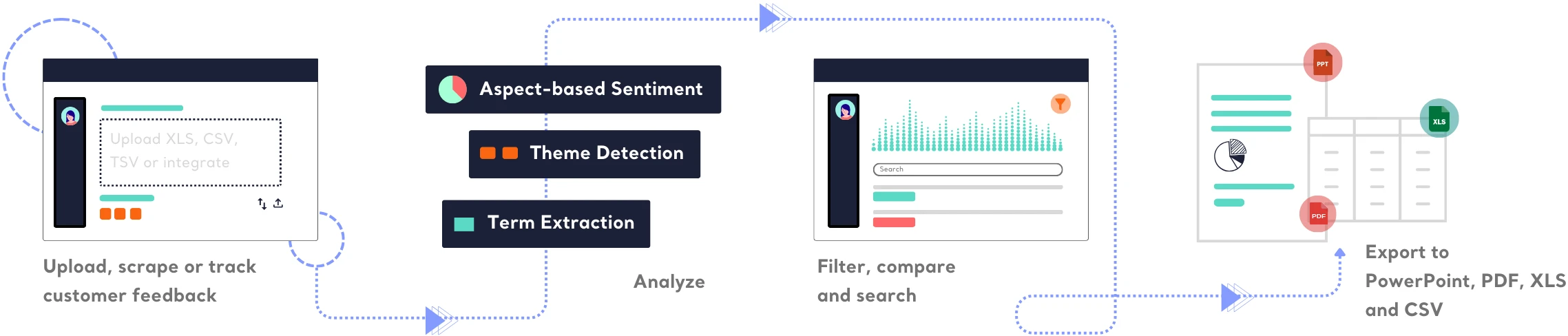
Find out how Kimola can improve your feedback analysis process.
-
![Kimola for Product Feedback Analysis]() Product Feedback Analysis
Product Feedback Analysis
Uncover customer needs, likes, and dislikes from product reviews and feedback.
-
![Kimola for E-commerce Feedback Analysis]() E-commerce Feedback Analysis
E-commerce Feedback Analysis
Analyze customer reviews and ratings to optimize online shopping experiences.
-
![Kimola for Social Feedback Analysis]() Social Feedback Analysis
Social Feedback Analysis
Extract insights from social media conversations and online discussions.



-
![Kimola for Open-ended Survey Analysis]() Open-ended Survey Analysis
Open-ended Survey Analysis
Make sense of free-text survey responses with AI-powered analysis.
-
![Kimola for Conversational Analysis]() Chatbot and Call Center Conversational Analysis
Chatbot and Call Center Conversational Analysis
Understand customer sentiment and concerns from chat and call transcripts.
-
![Kimola for Employee Feedback Analysis]() Employee Feedback Analysis
Employee Feedback Analysis
Identify workplace trends and employee sentiment from internal feedback and reviews.



Frequently Asked Questions
About News Classifier
-
Can I add custom categories?
The current model operates with a fixed set of 12 categories. However, it is possible to develop a derivative model based on this framework to accommodate custom categories tailored to your organization’s needs.
-
Which languages does the model ?
News Classifier supports multiple languages, including English, Spanish, German, Dutch, and French. It can process multilingual datasets seamlessly, allowing cross-language classification and comparative trend analysis.
-
What file formats are supported for input?
The model accepts news content in .xls, .xlsx, .csv, .tsv formats, providing flexibility for various data sources.
-
Is my data secure?
Yes. Uploaded data is only used for classification and is never shared with third parties.
-
Do I need technical expertise to use the model?
No. The model provides a user-friendly interface that allows you to drag and drop your files and instantly classify news content without requiring any technical knowledge.
-
Can the model handle large-scale datasets?
Yes. News Classifier is designed to scale efficiently, capable of processing thousands of news articles quickly while maintaining accurate classification.
-
How does the model handle ambiguous or very short articles?
For content that does not clearly fit any of the 12 categories, the model outputs “None”, ensuring that ambiguous, incomplete, or low-information articles are filtered rather than misclassified.
Turn customer feedback into structured market research in 30+ languages—no AI training needed.
Create a Free Account No credit card · No commitment